



Toronto Maple Leafs’ Seven-Game Losing Streak: What’s Gone Wrong in Toronto?
The Toronto Maple Leafs are facing an increasingly difficult start to the...

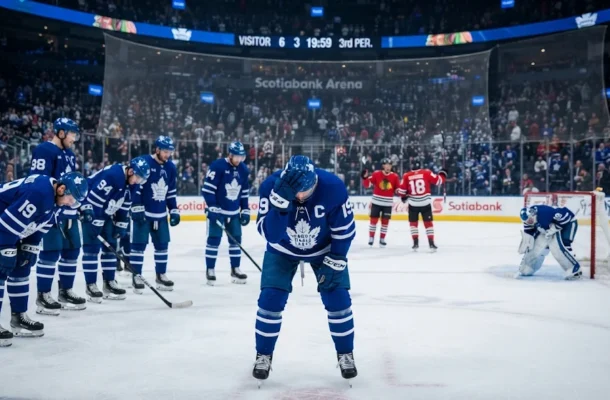
The Toronto Maple Leafs are facing an increasingly difficult start to the 2026–27 NHL season, and their latest seven-game losing streak has raised serious questions about the direction of the franchise. A team that entered the season expecting to compete for a playoff position now finds itself struggling near the bottom of the Atlantic Division, searching for answers at both ends of the ice.
Toronto’s latest setback, a 6–3 defeat against the Chicago Blackhawks on November 17, extended the losing streak to seven consecutive games. The Maple Leafs have now fallen to an 8-13-2 record, leaving them with just 18 points through 23 games.
For a franchise with championship aspirations and one of the NHL’s most recognizable fan bases, the situation is becoming increasingly uncomfortable.
But what exactly is going wrong?
Is this simply a temporary scoring slump? Are the team’s defensive problems becoming too significant to overcome? Are some of Toronto’s highest-paid players failing to deliver when the team needs them most?
A closer examination of the Maple Leafs’ recent performances suggests that the problems are more complicated than a few unlucky results.
Seven Consecutive Losses: A Season Losing Momentum
Toronto’s losing streak began on November 3 against the Utah Mammoth and has continued through games against Montreal, New Jersey, Colorado, Minnesota, Edmonton and Chicago.
• November 3: Lost 3–2 to Utah.
• November 7: Lost 4–2 to Montreal.
• November 8: Lost 4–0 to New Jersey.
• November 10: Lost 6–3 to Colorado.
• November 12: Lost 5–2 to Minnesota.
• November 14: Lost 1–0 to Edmonton.
• November 17: Lost 6–3 to Chicago.
During those seven games, Toronto managed just 12 goals while surrendering 29.
That works out to approximately 1.71 goals scored per game and 4.14 goals allowed per game.
Those numbers tell an alarming story.
The Leafs have been unable to generate consistent offence, while their defensive coverage and goaltending have struggled to keep opponents off the scoreboard.
Six of the seven defeats came by multiple goals, and Toronto was shut out twice.
Perhaps most concerning is that this downturn followed a much stronger opening stretch. Through their first 16 games, the Leafs scored 60 goals, averaging 3.75 per game.
The contrast between those two periods is substantial.
Toronto has gone from being a productive offensive team to one struggling to generate even two goals per night.
Auston Matthews: The Captain Isn’t the Main Problem
When a team loses seven consecutive games, its captain inevitably becomes a major part of the discussion.
For Toronto, that means Auston Matthews.
However, Matthews’ individual production suggests that pointing the finger directly at the captain would be misplaced.
Through 23 games, Matthews has recorded:
• 12 goals
• 18 assists
• 30 points
• Plus-7 rating
Those numbers make him Toronto’s leading scorer and one of the few players maintaining a strong individual performance despite the team’s difficulties.
His plus-7 rating is particularly interesting considering Toronto’s overall struggles.
It suggests Matthews has generally been contributing positively when he is on the ice, even as the team around him has experienced considerable difficulty.
The problem is that individual production does not automatically translate into team success.
Matthews needs consistent support from the players surrounding him. Toronto cannot expect its captain to generate offence, provide leadership, carry the defensive responsibilities and somehow compensate for every weakness elsewhere in the lineup.
Matthews has also publicly acknowledged that the team has been abandoning its game plan and failing to compete consistently for a full 60 minutes.
That observation is significant.
The Maple Leafs do not simply need more goals from their captain. They need a more consistent collective effort.
William Nylander: A Concerning Drop in Production
William Nylander is another major part of Toronto’s offensive identity, but his recent performances have become a significant concern.
Nylander entered the losing streak as one of the team’s leading offensive contributors. Through 23 games, he has recorded 11 goals and 11 assists for 22 points.
However, his recent production has fallen dramatically.
Nylander has failed to register a point in his last five games, and his minus-8 rating during that stretch illustrates the difficulties he has experienced.
His performance against Colorado was particularly disappointing, finishing with a minus-4 rating.
Toronto’s coaching staff has responded by experimenting with different forward combinations, including moving Nylander down to the third line during the November 19 morning skate.
That is a notable development for a player expected to be one of the team’s primary offensive weapons.
Nylander possesses the skating ability, puck-handling skills and offensive instincts to change games. However, Toronto needs more consistent contributions from him, particularly when Matthews is unable to carry the offensive workload alone.
The question now is whether Nylander’s struggles are temporary or whether they reflect a larger problem with Toronto’s offensive structure.
John Tavares: Experience and Leadership Under Pressure
John Tavares remains an important veteran presence in the Maple Leafs’ dressing room, but his contribution has become another area of concern.
His production has been considerably lower than Toronto would expect from a player occupying such an important role.
Tavares has recorded eight points in 13 games and carries a minus-13 rating.
That is a difficult combination for a team already struggling to find consistency.
Tavares brings considerable experience, strong positioning around the net and the ability to contribute offensively. However, Toronto needs more production from its veteran centre.
His responsibilities extend beyond putting points on the scoreboard.
As one of the team’s established leaders, Tavares must help stabilize the dressing room, particularly when younger players are experiencing the frustration of an extended losing streak.
The Leafs need their veteran players to establish a consistent standard of performance.
At this point, that standard has been difficult to find.
Easton Cowan: A Bright Spot During a Difficult Period
Not everything about Toronto’s season has been disappointing.
Easton Cowan has emerged as one of the more encouraging developments.
Through 23 games, the young forward has recorded eight goals and nine assists for 17 points.
His plus-1 rating is also noteworthy, particularly when compared with several more experienced teammates.
Cowan represents an important part of Toronto’s future, and his early contributions suggest he can become a meaningful offensive presence.
The challenge for the organization is ensuring that young players are developed in a positive environment rather than being forced to compensate for problems throughout the roster.
Cowan should be allowed to develop his game while benefiting from opportunities alongside experienced players.
If Toronto can eventually establish a more consistent offensive structure, his contributions could become even more valuable.
The Goaltending Situation: A Major Concern
Perhaps no aspect of Toronto’s current situation deserves more attention than its goaltending.
Sergei Bobrovsky and Anthony Stolarz have experienced very different starts to the season.
Their reported statistics through 23 games are:
Sergei Bobrovsky 3-9-2 .874 save percentage, 3.65 GAA
Anthony Stolarz 5-4-0 .906 save percentage, 2.69 GAA
Bobrovsky’s numbers are particularly concerning.
A .874 save percentage and 3.65 goals-against average are not the numbers Toronto needs from its starting goaltender. Stolarz, meanwhile, has produced considerably better results. His .906 save percentage and 2.69 goals-against average suggest he has been the more reliable option.
However, it would be unfair to place the entire responsibility for Toronto’s problems on its goaltenders.
A goalie can only do so much when defensive coverage breaks down and opponents are consistently given quality scoring opportunities.
Toronto needs better defensive support, improved communication and more consistent performances from both goaltenders. The organization must also determine how it intends to distribute the workload between its two netminders.
Defensive Problems Are Undermining the Team
The Maple Leafs’ defensive performance has been one of the biggest disappointments of the losing streak. Allowing 29 goals over seven games is not sustainable for a team hoping to qualify for the Stanley Cup Playoffs.
Defensive breakdowns have placed additional pressure on the goaltenders and forced Toronto to spend too much time defending its own zone.
Morgan Rielly, Chris Tanev, Jake McCabe and Oliver Ekman-Larsson are among the defencemen expected to provide stability.
Toronto needs this group to establish a more dependable defensive identity. That means limiting turnovers, improving puck management, protecting the front of the net and preventing opponents from generating repeated second-chance opportunities. A team cannot expect to win consistently while surrendering four goals per game.
Even an offence capable of producing three or four goals on a regular basis would struggle under those circumstances.
The Power Play and Penalty Kill: Not Everything Is Broken
Interestingly, Toronto’s special teams have been among the more encouraging aspects of its overall performance. The Maple Leafs have a power-play efficiency of approximately 25.4 per cent, ranking seventh in the NHL. Their penalty kill is also operating at approximately 83.6 per cent, placing it seventh. This is important because it suggests that Toronto’s problems are not necessarily rooted in every area of its game. The special teams have demonstrated an ability to compete at a relatively high level.
T
he bigger problem is five-on-five consistency, offensive production during the losing streak and the team’s inability to prevent opponents from taking control of games.
If Toronto can improve its even-strength play without sacrificing its special-teams performance, there is at least a foundation upon which to build.
What Must Change for the Maple Leafs?
Seven consecutive losses should be enough to force an honest assessment of the team’s performance.
There are several areas that require immediate attention.
Is This a Temporary Slump or a Bigger Problem?
The Toronto Maple Leafs’ seven-game losing streak is more than an unfortunate sequence of results. It has exposed several weaknesses that the organization must address if it hopes to turn its season around.
Auston Matthews continues to produce offensively, Easton Cowan has shown considerable promise, and the special teams have performed reasonably well. However, William Nylander’s recent disappearance from the scoresheet, John Tavares’ limited production, defensive inconsistencies and concerning goaltending numbers have combined to create a difficult situation.
Toronto is now 8-13-2, and the margin for error is shrinking. The immediate challenge is the November 19 matchup against the Los Angeles Kings. The Maple Leafs need a convincing response, not simply another performance in which they remain competitive for a period before allowing the opposition to take control.
The question facing the organization is no longer whether the team has enough individual talent. It is whether that talent can be organized into a consistent, competitive hockey team. For a franchise and fan base that have waited decades for another Stanley Cup championship, another disappointing season would be difficult to accept.
The Leafs still have time to change the narrative, but the urgency is growing. Toronto needs to find answers quickly. Seven consecutive losses are a warning sign that cannot be ignored.

The Toronto Maple Leafs are facing an increasingly difficult start to the...

The hockey world is mourning the loss of former NHL star Claude...

As the 2026 Winter Olympics in Milano?Cortina approach, the global hockey spotlight...

Brady Tkachuk is frequently described as the heartbeat of the Ottawa Senators...

Newfoundland Hockey Talk has learned that there is considerable doubt surrounding the...

The current makeup of Triple “AAA” Peewee and Bantam hockey within our...

Newfoundland Senior Hockey has seen its share of controversy in the past....

With the Corner Brook Royals in Gander this weekend for some hockey...